Essay
Free Plagiarism Checker for Students
Check your academic writing for potential plagiarism before submitting your work.
Java Assistant's free plagiarism checker helps students review written content for possible similarities with existing online sources and identify areas that may require citation, rewriting, or further review.
Whether you are working on an essay, research paper, assignment, thesis, or graduation project, checking your work before submission can help improve academic integrity and referencing quality.
Check Plagiarism Online for Free
Students can use the plagiarism checker to review academic text and look for potential matching or similar content.
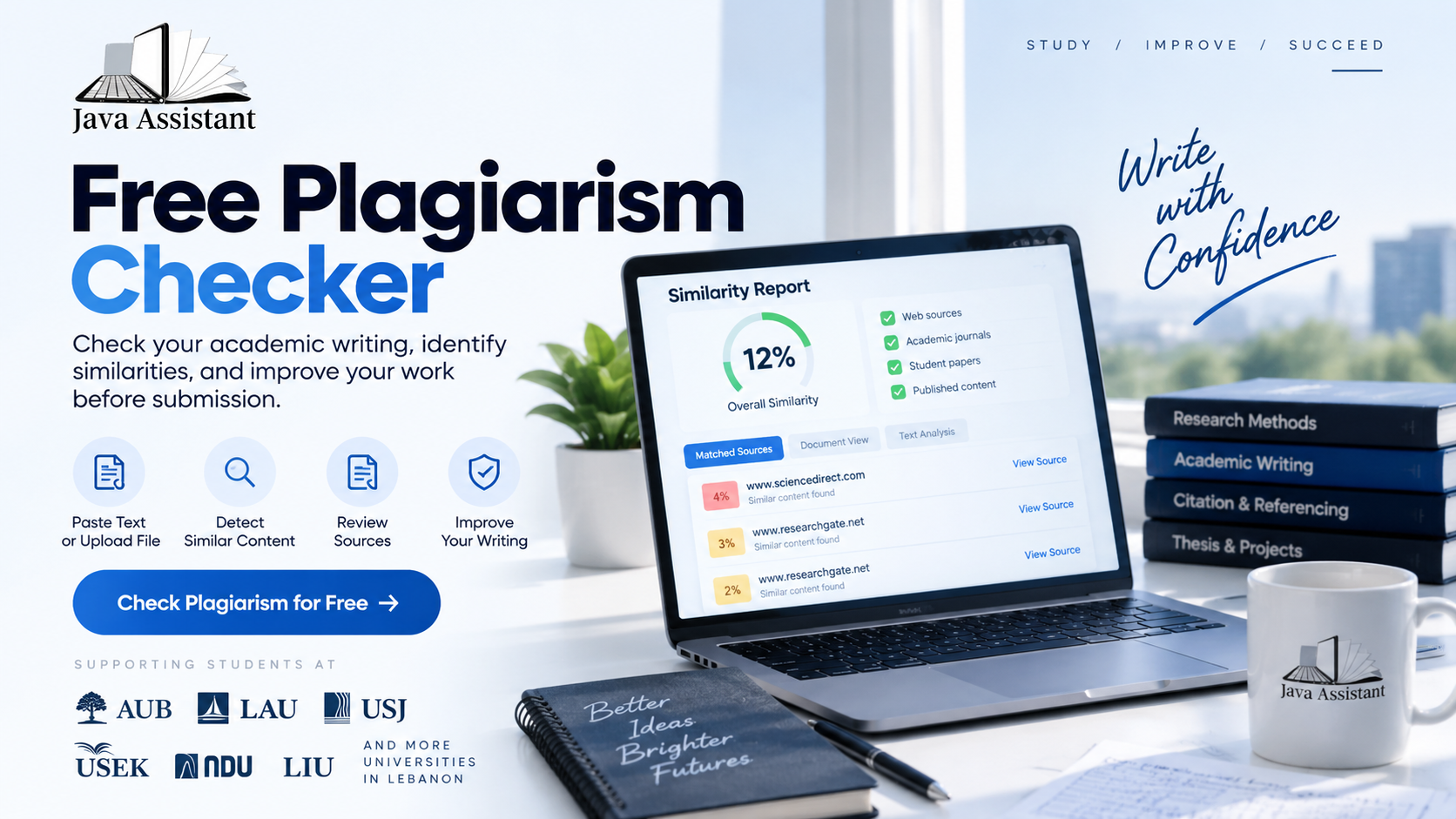
The process is simple:
- Add or upload your text.
- Start the plagiarism check.
- Review the detected similarities.
- Examine potentially matching sections.
- Add citations or rewrite sections where appropriate.
- Review your document before submission.
The objective is not simply to achieve a low similarity percentage.
Students should understand why content was identified as similar and determine whether it has been correctly quoted, paraphrased, or referenced.
What Does a Plagiarism Checker Detect?
A plagiarism checker compares submitted text against available sources to identify potentially similar wording or content.
Depending on the available database and detection technology, similarity may be found in:
- Websites
- Online articles
- Published content
- Research material
- Public documents
- Previously indexed online sources
A similarity match does not automatically mean plagiarism.
For example, commonly used terminology, correctly quoted text, references, titles, and standard academic phrases may appear as similarities.
The student should review each match individually.
Free Plagiarism Checker for Students
University students frequently use plagiarism checking when preparing:
- Essays
- Assignments
- Research papers
- Reports
- Thesis chapters
- Dissertations
- Graduation projects
- Literature reviews
- Case studies
- Academic articles
Checking a document before submission can help students identify citation or paraphrasing issues early.
Plagiarism Checker for Essays
Essays often include ideas, definitions, theories, and information obtained from academic sources.
When incorporating information from another author, students should make sure that sources are properly acknowledged.
A plagiarism check can help identify passages that may be too similar to the original source.
Students can then review whether the section should be:
- Rewritten
- Properly paraphrased
- Quoted
- Referenced
- Cited according to the required academic style
Plagiarism Checker for Research Papers
Research papers depend heavily on existing literature.
This makes proper citation especially important.
A plagiarism checker may help students review their research paper before submission and identify sections requiring additional attention.
Common areas to review include:
- Literature reviews
- Background sections
- Definitions
- Research methodology descriptions
- Discussions of previous studies
- Theoretical frameworks
Researchers should always follow the citation style required by their university, journal, or supervisor.
Thesis Plagiarism Checker
A thesis can contain thousands of words and dozens or even hundreds of references.
This increases the importance of reviewing citations and source attribution carefully.
Students may use a plagiarism checker during different thesis stages rather than waiting until the final submission.
For example:
Proposal → Literature Review → Methodology → Results → Discussion → Final Thesis Review
Checking individual chapters can make it easier to identify and correct potential issues throughout the research process.
Similarity vs Plagiarism
Similarity and plagiarism are not exactly the same thing.
Similarity
Similarity means that some text resembles content found in another source.
This can include legitimate content such as:
- Correct quotations
- References
- Standard terminology
- Common phrases
- Titles
- Technical definitions
Plagiarism
Plagiarism generally refers to presenting another person's words, ideas, or work without appropriate acknowledgment.
Therefore, a similarity percentage should not be interpreted automatically as a plagiarism percentage.
Each highlighted section should be reviewed in context.
How to Reduce Plagiarism Correctly
The goal should not be to artificially manipulate a similarity score.
Instead, students should improve the academic quality of their writing.
1. Cite Your Sources
When using another author's idea or information, include the appropriate citation.
2. Paraphrase Properly
Paraphrasing means expressing an idea genuinely in your own words while preserving the original meaning.
Changing only a few words is usually not sufficient.
3. Use Quotation Marks
When directly using another author's exact wording, quotation marks and citations should normally be used according to the required citation style.
4. Maintain a Reference List
Keep track of all sources used throughout your research.
5. Check Before Submission
Running a plagiarism check before final submission gives you time to review potential issues.
Common Academic Citation Styles
Different universities and departments use different citation systems.
Common styles include:
- APA
- Harvard
- IEEE
- MLA
- Chicago
- Vancouver
Students should always follow the referencing style required by their course, faculty, supervisor, or university.
Plagiarism Checker for Thesis and Graduation Projects
Large academic projects usually include research from numerous sources.
Examples include:
- Thesis projects
- Senior projects
- Capstone projects
- Graduation projects
- Final-year reports
A plagiarism checker can help students review documentation and research sections before final submission.
Technical projects may also contain standard terminology or technical descriptions, so detected similarities should always be interpreted carefully.
Can a Plagiarism Checker Guarantee Zero Plagiarism?
No plagiarism checker can guarantee that a document contains absolutely no plagiarism.
Different plagiarism detection systems may use different:
- Databases
- Search indexes
- Matching algorithms
- Academic repositories
- Detection methods
Results can therefore vary between platforms.
The plagiarism checker should be considered a review tool, not a guarantee of the result produced by a university's own plagiarism detection system.
Is This the Same as Turnitin?
No.
Unless explicitly stated otherwise, Java Assistant's plagiarism checking service should not be considered an official Turnitin similarity report.
Turnitin uses its own databases and detection systems, so results from different plagiarism-checking platforms may vary.
If your university requires an official Turnitin report, follow your university's submission process.
What Is a Good Plagiarism Percentage?
There is no universal plagiarism or similarity percentage that applies to every university.
Acceptable similarity may depend on:
- University policy
- Faculty requirements
- Assignment type
- Citation style
- Research discipline
- Supervisor instructions
- Content included in the similarity report
Students should not focus only on the overall percentage.
The nature of each similarity match is more important than the number alone.
Why Check Your Work Before Submission?
Reviewing academic work before submission gives students an opportunity to:
- Identify missing citations
- Improve paraphrasing
- Correct references
- Review quotations
- Detect accidental similarities
- Improve academic integrity
- Make final revisions
This is particularly useful for longer assignments and research projects.
Frequently Asked Questions
Is the plagiarism checker free?
Java Assistant provides a free plagiarism-checking option where available. Usage limits may apply depending on document size, account status, or service availability.
Can I check an essay for plagiarism?
Yes. Essays, assignments, reports, and other academic writing can be reviewed for potential similarities.
Can I check my thesis?
Yes. Thesis content can be checked, although large documents may be easier to review chapter by chapter.
Does plagiarism checking include AI detection?
Plagiarism detection and AI-writing detection are different technologies.
A plagiarism checker searches for similarities with existing content, while AI detection attempts to estimate whether content may have been generated using artificial intelligence.
Does a similarity match mean I plagiarized?
Not necessarily.
Similarity can occur for legitimate reasons, including quotations, citations, standard terminology, and common academic phrases.
Each match should be reviewed individually.
Will my plagiarism score be the same as Turnitin?
Not necessarily.
Different plagiarism detection services use different databases and algorithms, so similarity results can differ.
Can I remove plagiarism by paraphrasing?
Proper paraphrasing can help when a source has been used too closely, but the original source should still be cited when its ideas are being used.
Check Your Academic Writing
Review your essay, assignment, research paper, thesis, or graduation project before submission.
Use Java Assistant's free plagiarism checker to identify possible similarities, review citations, and improve your academic writing.
Start your plagiarism check today.
